The New Society
Author: Peter F. Drucker, 1950
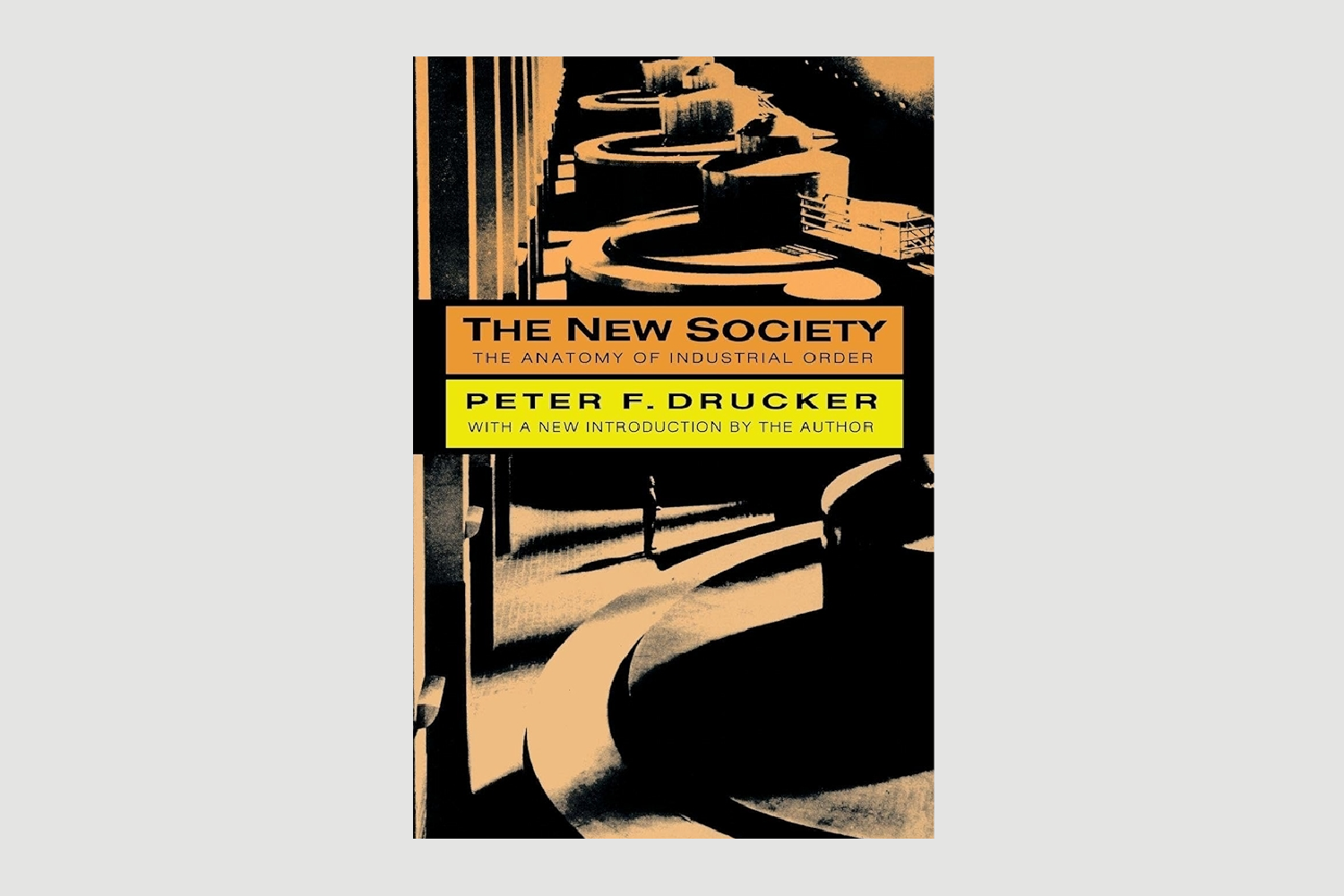
Book preface written by Drucker+ team.
Off the Shelf highlights the books of Peter F. Drucker. This week, we look at “The New Society: The Anatomy of Industrial Order,” first published in 1950.
In the introduction to the 1993 edition of the book, Drucker wrote that “The New Society” was the third part of a trilogy that included “The Future of Industrial Man” (1942) and “The Concept of the Corporation” (1946). All three investigated the rapid and significant changes industrial societies experienced in the mid-20th century and their effects on workers, businesses, and politics.
“The New Society” is a synthesis of the first two books that distills their conclusions “into a systematic, organized analysis, both theoretical and practical, of industrial society, its constituent elements, its major institutions, its social characteristics, its problems, and its future,” Drucker writes.
In the book, he discusses the importance of treating labor as a resource instead of purely as a cost, how both workers and enterprises benefit when workers can count on consistent employment and compensation, and the responsibilities that labor unions have to society as a whole.
The book is both theoretically ambitious and practical, proposing decentralized management structures, self-governing plant communities, and a reconception of labor unions as responsible citizens within industrial societies.
“The New Society... is a systematic, organized analysis, both theoretical and practical, of industrial society, its constituent elements, its major institutions, its social characteristics, its problems, and its future”
Official Book Synopsis on Amazon
In The New Society, Peter Drucker extended his previous works The Future of Industrial Man and The Concept of the Corporation into a systematic, organized analysis of the industrial society that emerged out of World War II. He analyzes large business enterprises, governments, labor unions, and the place of the individual within the social context of these institutions. Although written when the industrial society he describes was at its peak of productivity, Drucker's basic conceptual frame has well stood the test of time.
Following publication of the first printing of The New Society, George G. Higgins wrote in Commonweal that "Drucker has analyzed, as brilliantly as any modem writer, the problems of industrial relations in the individual company or 'enterprise.' He is thoroughly at home in economics, political science, industrial psychology, and industrial sociology, and has succeeded admirably in harmonizing the findings of all four disciplines and applying them meaningfully to the practical problems of the 'enterprise.'" This well expresses contemporary critical opinion.
Peter Drucker's new introduction places The New Society in a contemporary perspective and affirms its continual relevance to industry in the mid-1990s. Economists, political scientists, psychologists, and professionals in management and industry will find this seminal work a useful tool for understanding industry and society at large.