What Does Employee Engagement Really Mean?
People are the organization.
Drucker Institute’s Data Innovation Team
September 2026 Edition
By Xu Chen, The Drucker Institute Data Innovation Team
Leaders spend enormous amounts of time and money trying to improve employee engagement. They survey it, benchmark it, put it on dashboards, and ask managers to raise it.
But there is a more fundamental question that often goes unasked:
Engaged with what?
An employee can be deeply absorbed in the work without feeling much attachment to the organization. Another can believe strongly in the organization's mission and culture while feeling little energy for the work performed each day.
Those are not the same experience. And treating them as though they were may obscure exactly what management needs to understand.
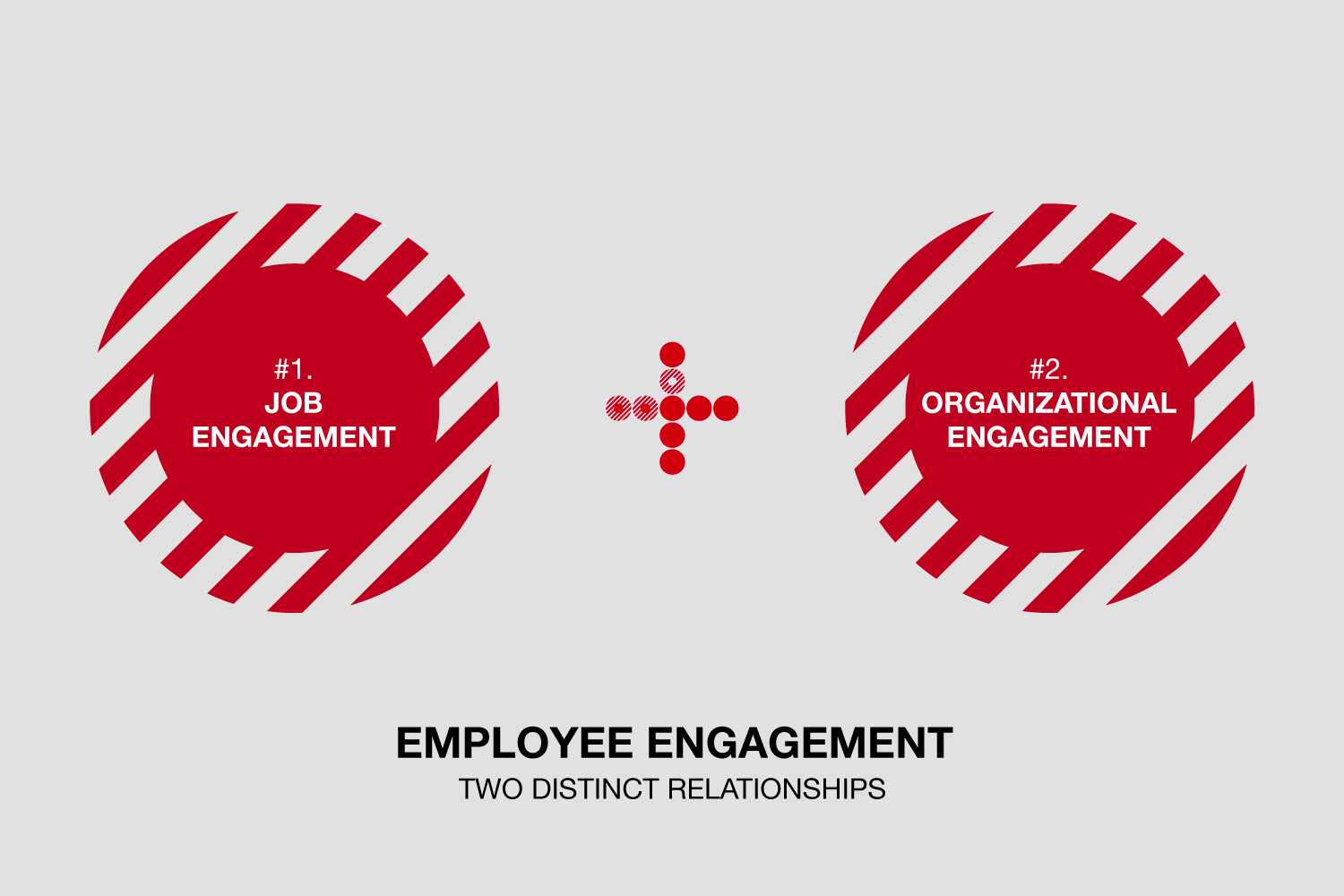
Our latest research suggests that employee engagement is better understood as two distinct relationships. The first is job engagement, whether a person feels absorbed, attentive, and energized by the work itself. The second is organizational engagement, whether a person feels connected to, involved in, and proud of the organization as a member.
The two can reinforce each other. But they do not always move together.
That distinction matters because each tells managers something different.
Engagement Is Not Just a Score
Peter F. Drucker consistently returned management to questions of contribution, responsibility, and purpose. The task of management was not simply to extract more effort from people. It was to create an organization in which people could make their strengths productive and contribute toward a common purpose.
Seen from that perspective, "employee engagement" is not one problem.
There is the relationship between a person and the work. Is the work absorbing? Does the individual have the opportunity to contribute? Are responsibility, autonomy, resources, and expectations arranged so that someone can do something worthwhile well?
And there is the relationship between a person and the institution. Does the employee trust its leadership? Identify with its purpose? Feel recognized as a member of a community pursuing something larger than an individual task?
Modern engagement measures often compress these experiences into a single score.
Our research asks what becomes visible when we separate them.
Listening to Employee Voice at Scale
Employees talk about their workplaces at enormous scale. They describe what gives them energy, what frustrates them, what they value, what they distrust, and what makes them consider leaving.
Much of that information eventually becomes a star rating, an average score, or a general measure of sentiment. Those measures can be useful. But they can also conceal important differences in what employees are actually telling us.
The Drucker Institute's Data Innovation Team analyzed more than 160,000 employee reviews covering 298 publicly traded companies from 2021 through 2024.
Rather than asking an artificial intelligence model to invent its own definition of engagement, we began with established management theory. We then examined whether employees' language reflected two theoretically distinct relationships: engagement with the job and engagement with the organization.
The distinction may sound subtle.
In the data, it was not.

When People Believe in the Organization
Organizational engagement behaved much like a broad evaluation of the workplace.
Companies with stronger organizational engagement tended to receive higher overall employee ratings, stronger culture ratings, and more positive employee sentiment. In other words, the language people used about belonging to the organization corresponded with other indications of how positively they experienced the institution.
That makes organizational engagement useful, but perhaps not in the way leaders might initially expect.
Its value appears primarily diagnostic rather than predictive. It can help management understand how employees experience the organization's culture, identity, leadership, practices, and sense of membership.
It helps answer an essential question:
How do people feel about being part of this organization?
That is important information. But it should not be confused with a stand-alone forecast of corporate performance.
When People Are Absorbed in the Work
Job engagement told a different story.
Employees could be deeply absorbed in their work without giving the organization an especially high rating. The job-engagement signal was largely distinct from overall ratings and general employee sentiment.
It appeared to capture something more specific: people's relationship with the work itself. That signal also showed a modest relationship with subsequent revenue and sales per employee, an imperfect but commonly used proxy for workforce productivity.
The evidence requires caution. The pattern did not reliably extend to profitability or market value, and it became less certain under stricter statistical tests.
So, the conclusion is not that employee language can predict corporate performance. It is more interesting than that.
Language about absorption in work may contain a distinctive signal about what is happening inside an organization that conventional employee ratings do not capture.
Promising is not proven. A useful signal is not a decision rule.
But it may tell management where to look.

The Management Problem Hidden by One Number
Imagine two organizations.
In the first, employees believe deeply in the mission and feel proud to belong to the institution. But they are detached from their daily work.
A conventional engagement score might tell management that something is wrong. Separating the two forms of engagement suggests where to begin looking: work design, role clarity, resources, autonomy, responsibility, or opportunities to make a meaningful contribution.
Now imagine another organization.
Its employees love what they do. They are absorbed in the work and committed to doing it well. Yet they feel disconnected from the institution around them.
That is a different management problem. It raises questions about trust, leadership, belonging, recognition, culture, and whether individual effort is connected to a shared purpose.
Neither measure identifies the cause.
But each helps management ask a better question.
Instead of asking only, "Are our employees engaged?" leaders should ask:
• Are people energized by the work they do?
• Do they feel connected to the organization in which they do it?
• Are those two relationships strengthening together or moving apart?
• What are we concealing when we report only the average?
The point is not to create two engagement scores where previously there was one.
It is to turn engagement from a number to be managed into a relationship to be understood.


AI Should Help Management Ask Better Questions
Artificial intelligence makes it possible to listen to employee language at a scale no executive team could achieve by reading reviews one at a time.
But that capability creates a temptation.
Once a human experience becomes measurable, managers can begin treating the measure as more complete and precise than it really is.
Employee-review data are imperfect. Reviews are voluntary. Some organizations receive thousands while others receive relatively few. People who choose to write reviews may differ from those who remain silent. An AI model can identify recurring patterns in language, but it cannot know the full human context in which every statement was made.
That is why these signals should be used to identify questions at the organizational level, not to evaluate individual employees, automate employment decisions, or replace direct conversation.
Surveys, interviews, employee reviews, operational measures, and financial information each provide a different window into the organization. None is the organization itself.
The responsible use of AI in management is therefore not to remove human judgment. It is to discipline it.
AI can help surface patterns. It can challenge assumptions. It can direct attention toward places managers might otherwise overlook. And, equally important, it can help distinguish what the evidence shows from what it does not.
“The responsible use of AI in management is therefore not to remove human judgment. It is to discipline it.”
From Measurement to Management
Three implications follow.
#1: First, define engagement before trying to improve it.
A program designed to strengthen employees' attachment to an organization may do little to make their work more absorbing. A job-redesign effort may make the work far more rewarding without repairing distrust in leadership.
Management needs to know which relationship it is trying to change.
#2: Second, diagnose before predicting.
Organizational engagement appears most useful as an indication of how employees experience the institution. Job engagement may offer a narrower signal related to productive capacity, but our evidence is not strong enough to justify automated forecasts or high-stakes decisions.
The value of these measures begins with helping leaders recognize where they need to investigate more carefully.
#3: Third, preserve the voice behind the metric.
Measurement should tell managers where to listen more closely. It should not turn employee experience into another target to optimize while forgetting the people who produced the data.
Drucker distinguished efficiency from effectiveness. A single engagement score may be efficient. It is easy to display, compare, benchmark, and report.
But it is not effective if it conceals the distinction management most needs to understand.
The managerial task is not to maximize an engagement number. It is to create the conditions in which people can contribute meaningfully through their work and participate meaningfully in the organization.
That requires measurement. But it also requires judgment, conversation, and a willingness to ask what lies behind the number.
If people are the organization, their voices deserve more than one number.
So the next time someone asks, "Are our employees engaged?" perhaps the better question is:
Engaged in what, and what are they telling us to manage differently?
What’s next?
This month, we have examined why engagement is not a single relationship and how separating engagement with work from engagement with the organization can reveal management questions that a single metric conceals.
Next month, we begin a three-part series tracing the path from employee policies to organizational effectiveness.
We will start by moving from employee voice to corporate practice: Are the policies and investments companies provide reflected in how employees actually experience their workplaces? Is "treating employees well" the same as employees feeling well treated?
Or might those measures, too, tell fundamentally different stories about the organization?
"People are the organization."
That conviction sits at the center of the research agenda we are launching this year. Peter Drucker taught that productivity is not simply the responsibility of the worker. It is a function of how organizations manage, measure, and support the people who do the work.
At the Drucker Institute’s Data Innovation Team, we are translating that insight into rigorous, actionable research. Our central aim is to understand how employee signals move over time, what they reveal about organizational health, and how they relate to financial outcomes.
Over the coming year, we will publish a series of short monthly pieces that pull back the curtain on our projects. Our purpose is straightforward. We want to make the best social science methods useful for leaders and boards so they can make clearer, evidence-based decisions about people and performance.
Read this original essay for a snapshot of the research agenda guiding our first major wave of work.

The Drucker Institute’s Data Innovation Team
Who Is Doing the Work
This effort reflects a genuinely cross disciplinary team.
Becky Reichard leads the conceptual framework and literature integration.
Daniel Martin coordinates data engineering and model implementation.
Chasen Jeffries is developing the fatal flaw framing.
Xu Chen leads the topic modeling and validation pipelines.
Dana Bellinger is writing the employee engagement methodology.
Emily Alpay De Ruyter is leading the financial performance modeling.
Steven Zhou provides consultation on quantitative methods and psychometrics.
See the full team on the Drucker Institute website.
Together, this mix of scholars, data scientists, and practitioners forms the engine required to translate rigorous research into practical insight.
At the Drucker Institute, we believe that what gets measured shapes what gets managed. If people are the organization, then understanding employee signals with clarity and discipline is not a side project. It is central to the work of building effective, responsible, and enduring enterprises.
Inspired by Drucker’s wisdom?
Peter Drucker changed how the world thinks about management.
The Drucker Institute promotes effective management and responsible leadership as foundational elements that contribute to Drucker’s vision for a thriving, resilient, and functioning society.
The Drucker School of Management applies those ideas today through its graduate education, research, and community engagement. Learn more about how they carry forward his vision.