Nine Years of the Management Top 250
What We’ve Learned About Effective Companies
By Michael H. Kelly, Executive Director, The Drucker Institute
When the Drucker Institute at Claremont Graduate University launched the “Management Top 250” with The Wall Street Journal in 2017, it was motivated by a question: could Peter Drucker’s philosophy of “doing the right things well” be measured?
“Doing the right things well.”
Lawrence A. Crosby, the scholar who designed and led the effort, believed it could. Concerned that business had become captive to quarterly earnings and short-term gains, Crosby sought to capture the true health of organizations — not according to profit alone, but by how well companies balanced performance with purpose. His goal was to provide empirical evidence that Drucker’s human-centered management philosophy could be translated into a measurable system.
From Philosophy to Data
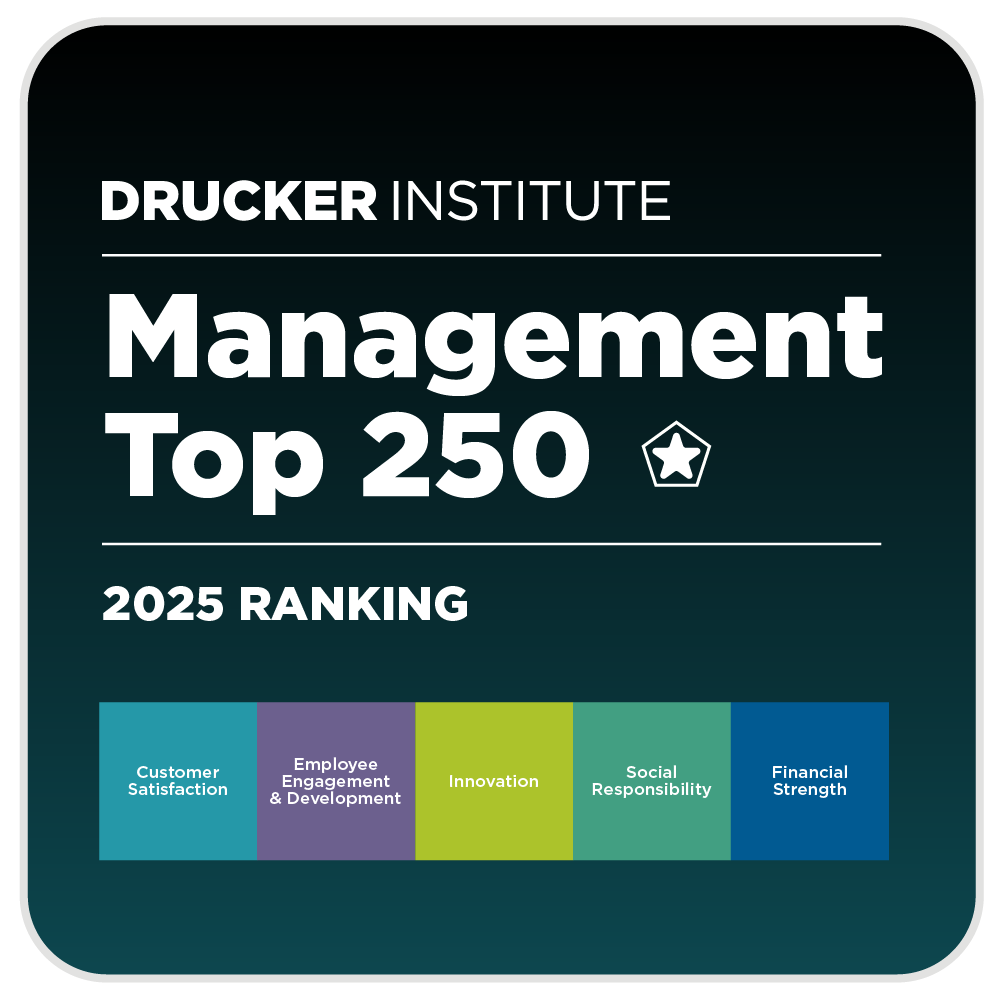
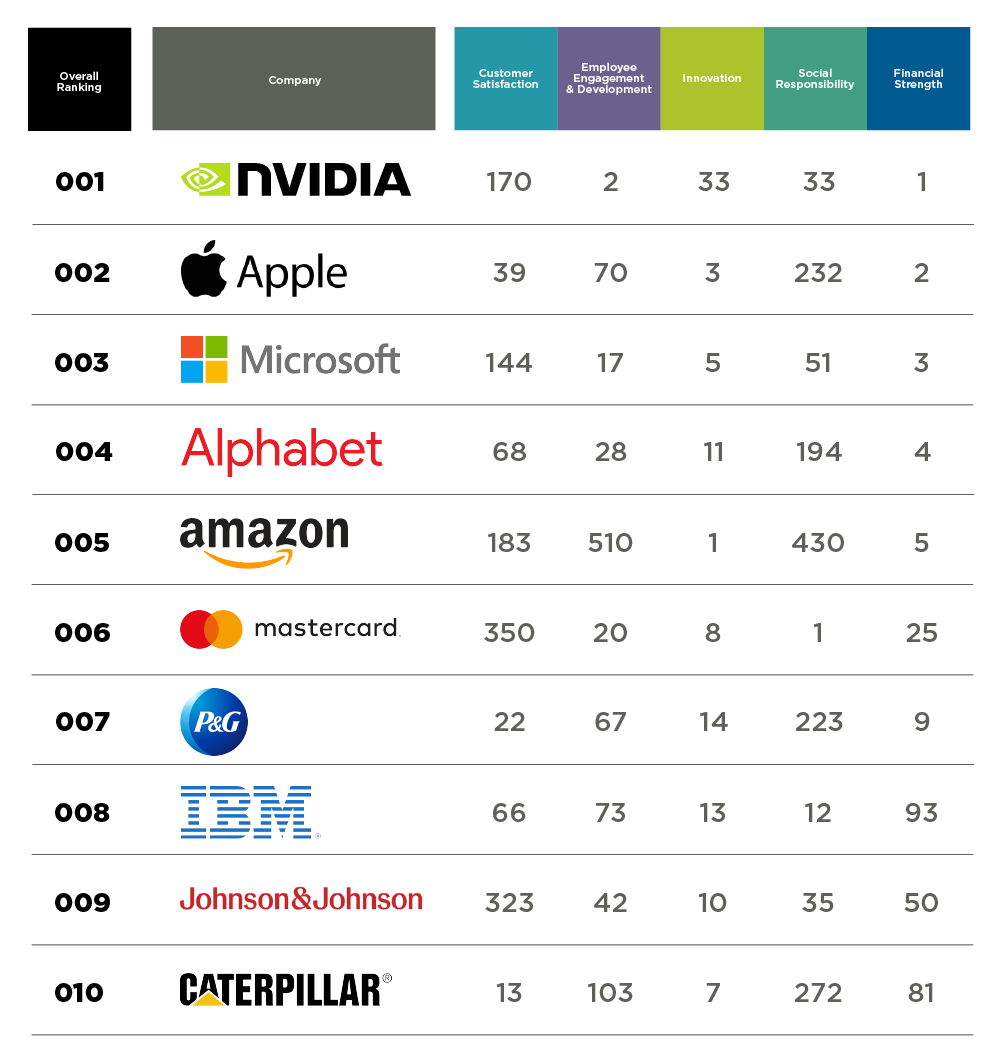
Drucker had long argued that a company’s legitimacy rests on its contribution to society — its ability to make human strengths productive and to serve the common good. Crosby transformed that idea into a framework built on five measurable dimensions: employee engagement and development, customer satisfaction, innovation, social responsibility, and financial strength.
Over several years, the Drucker Institute has aggregated credible third-party data from organizations like Glassdoor, the American Customer Satisfaction Index, Sustainalytics, and Clarivate Analytics about hundreds of firms. The Drucker Institute team validated these measurements using rigorous statistical modeling, an approach that is more akin to academic research than to traditional corporate rankings.
The early results confirmed Drucker’s insight. “Financial performance, customer satisfaction, employee engagement and development, innovation, and social responsibility can each be viewed as reflections of the overall health of the firm,” Crosby concluded. In other words, companies that invest in their people, customers, and communities are not trading off financial results but are reinforcing them.

A framework built on five measurable dimensions.
“Financial performance, customer satisfaction, employee engagement and development, innovation, and social responsibility can each be viewed as reflections of the overall health of the firm”
A Chain of Intangibles
Crosby’s research revealed what he called “a molecular model of effectiveness.” Each of the five dimensions interacted dynamically, producing a measurable chain of influence. Social responsibility increases employee engagement, leading to innovation and customer satisfaction, with the result being financial strength.
This pattern echoed Drucker’s thinking. Treat people with respect, and they will innovate. Innovate effectively, and customers will respond. Serve customers well, and profits follow. “This core chain,” Crosby wrote, “is the main path to profits for most firms.”
Subsequent analyses validated this insight. Over time, the model consistently separated high-performing firms from laggards and predicted long-term resilience.
While the measurement criteria don’t focus on company valuation, the results have been revealing. Portfolios composed of top-ranked companies have regularly outperformed the S&P 500, showing that Drucker’s balance of purpose and performance could also deliver superior returns.
“Portfolios composed of top-ranked companies have regularly outperformed the S&P 500, showing that Drucker’s balance of purpose and performance could also deliver superior returns.”
What Nine Years Have Revealed
Taken together, the past nine years of the Management Top 250 provides an informed analysis on the evolution of American management, capturing how leadership, culture, and performance have changed across nearly a decade of volatility. These are some key insights.
1. It still begins with people
From the earliest years, employee engagement and development have remained the most powerful predictor of overall effectiveness. Companies that improved in this category consistently climbed the rankings. Those that fell behind in workforce engagement slipped elsewhere as well. Drucker’s principle that “the yield from the human resource determines performance” remains empirically true.
2. Inclusion strengthens organizations
As workplace culture and belonging gained strategic importance, the data showed that firms with strong diversity and inclusion efforts outperformed peers not only in social responsibility, but also in innovation and customer satisfaction. Inclusion, in practice, has become a marker of management quality.
3. Responsibility drives results
Even as debates around ESG grew louder in recent years, the rankings have demonstrated that firms that score high in social responsibility also advance in innovation, engagement, and long-term profitability. Drucker’s view that social problems represent opportunities for management proved prescient.
4. Flexibility and balance matter
The pandemic reshaped work, and management lessons gained during that period have endured. Companies that achieved the right mix of in-person collaboration and remote flexibility show stronger innovation and engagement scores. These findings confirm that trust and adaptability — not control — are the true levers of performance.
5. Resilience defines leadership
The 2025 results mark what the Drucker Institute calls “The Year of Management Resilience.” After years of disruption, the data show steady improvement across all five dimensions.
This recovery, however, reflects discipline more than exuberance. Industries like healthcare, utilities, and industrial manufacturing now lead in stability and morale, while technology and finance, once symbols of speed and innovation, have matured through focus and efficiency. The year’s report concludes that “doing fewer things better” has become the most durable form of leadership.
At the same time, the results signal a challenge ahead. While many firms have mastered complexity, fewer have rediscovered conviction. The report asks: Can corporate America regain its sense of purpose, not just protect it?
A Living System of Effectiveness
After nearly a decade of research, one conclusion stands out: effectiveness is not a fixed trait but a living system. Crosby compared it to the human body, with each organ dependent on the others. Employee engagement is the energy source; innovation circulates new ideas; customer satisfaction reflects external health; social responsibility acts as the immune system; and financial strength is a vital sign.
The metaphor endures because the data confirm it. Companies that balance all five systems outperform those that chase a single metric. Short bursts of profit or innovation fade quickly, but long-term vitality depends on balance, on managing the whole rather than the parts.
From Measurement to Redefinition
This insight has set the stage for the Drucker Institute’s next chapter. In 2025, the institute established the Corporate Effectiveness Data Innovation Team to advance the science of management measurement. The new group is building on Crosby’s model by using artificial intelligence, machine learning, and advanced data modeling to better capture the relational and seemingly intangible characteristics that drive organizational performance.
The team’s purpose is to refine how management effectiveness is assessed and to create predictive tools that help organizations act on Drucker’s principles in real time. Its work will extend beyond rankings, developing new proprietary metrics for the five Drucker dimensions and partnering with companies and foundations to translate insights into practical strategy.
The initiative reflects a broader evolution in management itself. As firms face growing complexity, technology and data are becoming the means by which Drucker’s timeless ideas are reinterpreted. The question is no longer whether effectiveness can be measured, but how it can be improved and sustained.
The Road Ahead
Larry Crosby began this work to prove that management could be measured. Nine years later, the Management Top 250 has shown that not only can it be measured, but it also can be understood, and, increasingly, strengthened. The 2025 data suggest that American management has reached a new plateau of competence; the challenge now is to pair this competence with conviction.
If the first decade of this research taught us what effectiveness looks like, the decade ahead will explore how to build effectiveness and how clarity, trust, and purpose can power organizations that serve both performance and society.
As Drucker wrote, “Management is not just a branch of knowledge. It is a social function.” We now see how data support this philosophy. Effectiveness, as Crosby envisioned, is measurable. But the future of management will depend on something that is harder to quantify: the courage to lead with purpose.
“Management is not just a branch of knowledge. It is a social function.”
Inspired by Drucker’s wisdom?
Peter Drucker changed how the world thinks about management.
The Drucker School of Management applies those ideas today through its graduate education, research, and community engagement. Learn more about how they carry forward his vision.
The Drucker Institute promotes effective management and responsible leadership as foundational elements that contribute to Drucker’s vision for a thriving, resilient, and functioning society.