
Each year, the Drucker Institute releases the “Management Top 250,” a list of America’s most-effective companies that is published in the Wall Street Journal.
The Drucker Institute’s ranking highlights America’s top publicly-traded companies who are “Doing The Right Things Well” based on their effectiveness and ability to contribute to a “Functioning Society” according to Peter F. Drucker’s five key dimensions:


Peter F. Drucker believed that a company’s legitimacy rests on its contribution to society, its ability to make human strengths productive in the service of the common good. But how can these contributions be measured?
PREFACE
The question gets to the heart of the age-old philosophical tension between qualitative assessments and quantitative measurements. The characteristics that define great organizations in Drucker’s eyes are seemingly resistant to the analytical rigor that modern businesses demand. Yet if these qualities are real, if they genuinely drive organizational performance, there must be some way to measure them.
When the Drucker Institute launched the Management Top 250 rankings in 2017, it set out to resolve this tension by providing empirical evidence that Drucker’s human-centered management philosophy could be represented in a measurable system.
The methodology for the rankings, developed by Lawrence A. Crosby, formerly a dean at the Peter F. Drucker and Masatoshi Ito Graduate School of Management, translated Drucker's thinking about what makes for a successful business into five measurable dimensions: employee engagement and development, customer satisfaction, innovation, social responsibility, and financial strength.
Together, these dimensions can be viewed as reflections of the overall health of a firm. Over time, this methodology has consistently separated high-performing firms from laggards.
The best performing companies advanced by refining their systems, talent pools, and purpose rather than solely chasing scale. While the risk-taking we observed in previous years eased, practical innovation remained alive and well in AI, automation, and applied R&D, as we saw a pivot from rapid invention to purposeful application.
The focus on employee engagement in different sectors was the sharpest contrast in corporate America. Industrials and service sectors continued to invest in corporate culture and skill-building, while tech and financial firms focused on managing efficiency.
Technology, finance, and consumer goods — traditionally engines of disruption — saw slower momentum as cost controls and regulation took hold. Health care, utilities, and industrials became the backbone of stability, displaying strength in both execution and employee morale.
Although stock price in not the focus of our ranking, the results were revealing. Portfolios composed of top-ranked companies in the model regularly outperformed the S&P 500, illustrating that Drucker’s balance of purpose and performance can deliver superior returns.
Overall, the companies that performed best in the rankings were those that prioritized trust, focus, and purpose over scale. This year’s best-managed companies were those that did fewer things but did them well, which is a durable form of leadership.
The 2025 rankings demonstrate that corporate America has entered a phase of measured progress, a period of being more competent than cautious.
2025: THE YEAR OF “MANAGEMENT RESILIENCE”
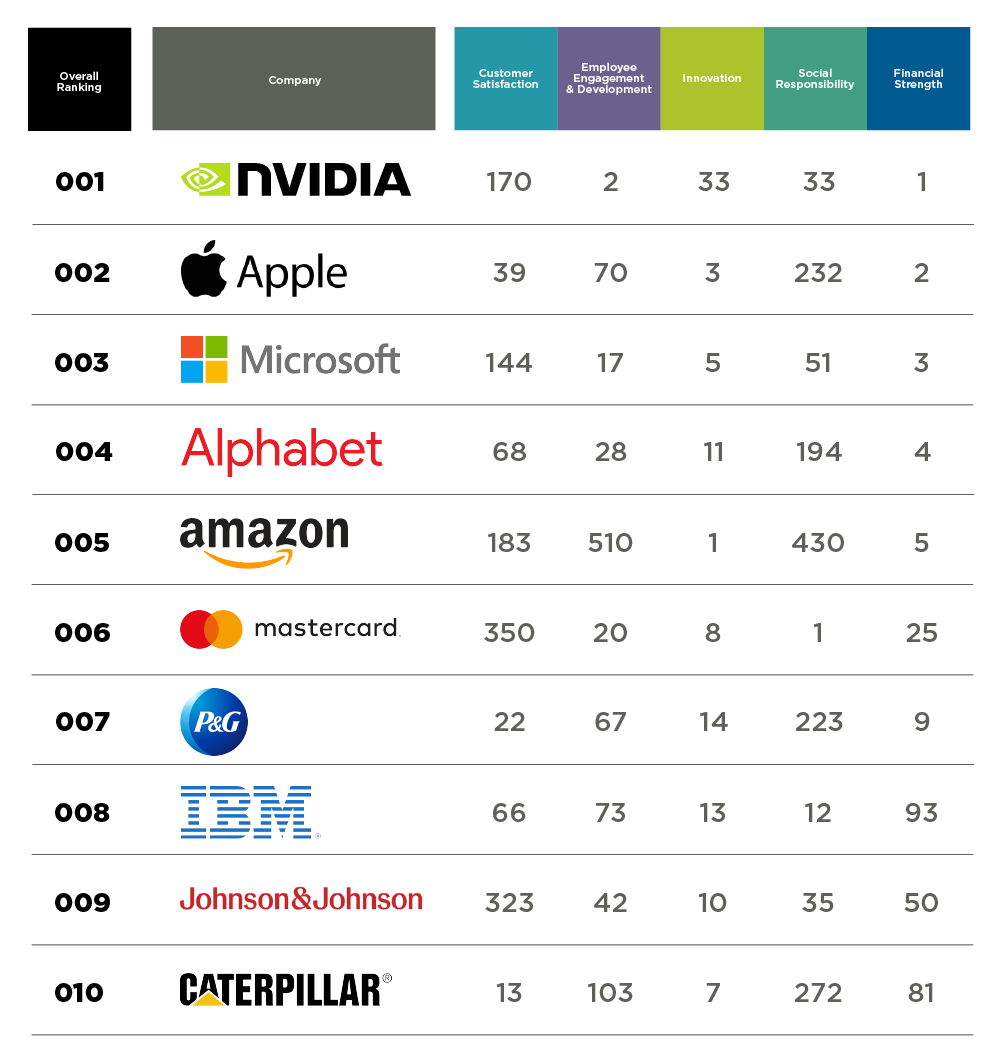
The 2025 data capture a maturing corporate landscape where companies have learned to manage complexity while struggling to rediscover conviction.
The most-effective firms balanced purpose and profit without overpromising. The laggards were not reckless — they were hesitant.
It is, of course, impossible to know what lies ahead for American business. Firms face uncertainties related to automation, global trade, and geopolitical conflicts. But as 2025 comes to a close, and we look to the year ahead, we wonder if it will be a period in which corporate America regains its sense of purpose instead of just protecting it.
What the future holds.
LEARN MORE


If your company is featured in the Management Top 250 and you would like more information about your ranking or branded assets to promote your inclusion, please email Michael Kelly, executive director of the Drucker Institute, at michael.kelly@cgu.edu
CONTACT & MEDIA
Michael H. Kelly
Executive Director
The Drucker Institute

ESSAY
Nine Years of the Management Top 250:
What We’ve Learned About Effective Companies
When the Drucker Institute at Claremont Graduate University launched the Management Top 250 with The Wall Street Journal in 2017, it began as a question more than a ranking: could Peter Drucker’s philosophy of “doing the right things well” be measured?
Lawrence A. Crosby, the scholar who designed and led the effort, believed it could. Concerned that business had become captive to quarterly earnings and short-term gains, Crosby sought to capture the true health of organizations—not through profit alone, but by how well they balanced performance with purpose. His goal was to provide empirical evidence that Drucker’s human-centered management philosophy could be translated into a measurable system.
Michael H. Kelly
Executive Director
The Drucker Institute
AUTHOR