Why Peter Drucker’s A Functioning Society Matters Now
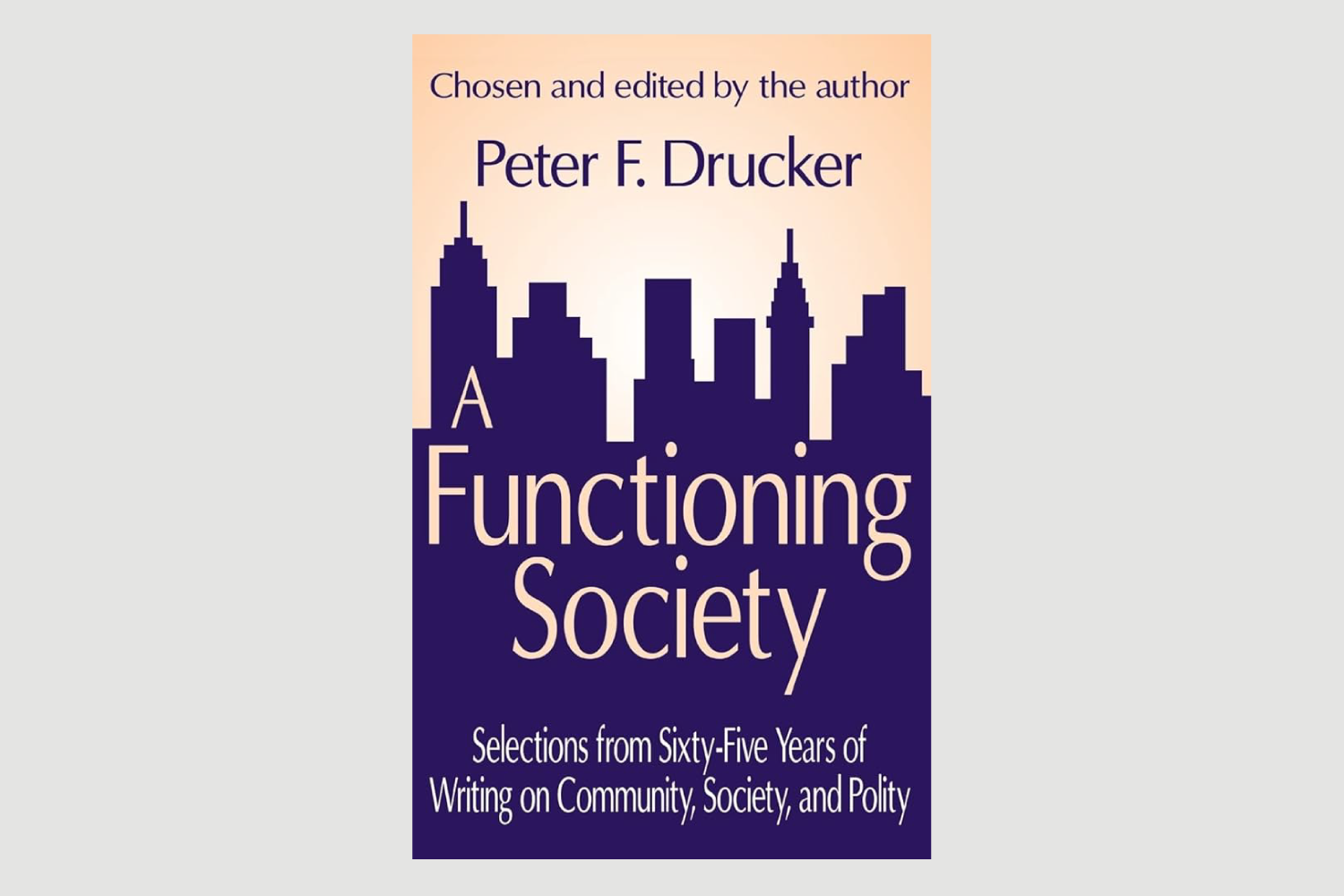
This essay explores why Peter Drucker’s audiobook A Functioning Society offers an essential framework for understanding institutional responsibility and social breakdown today.
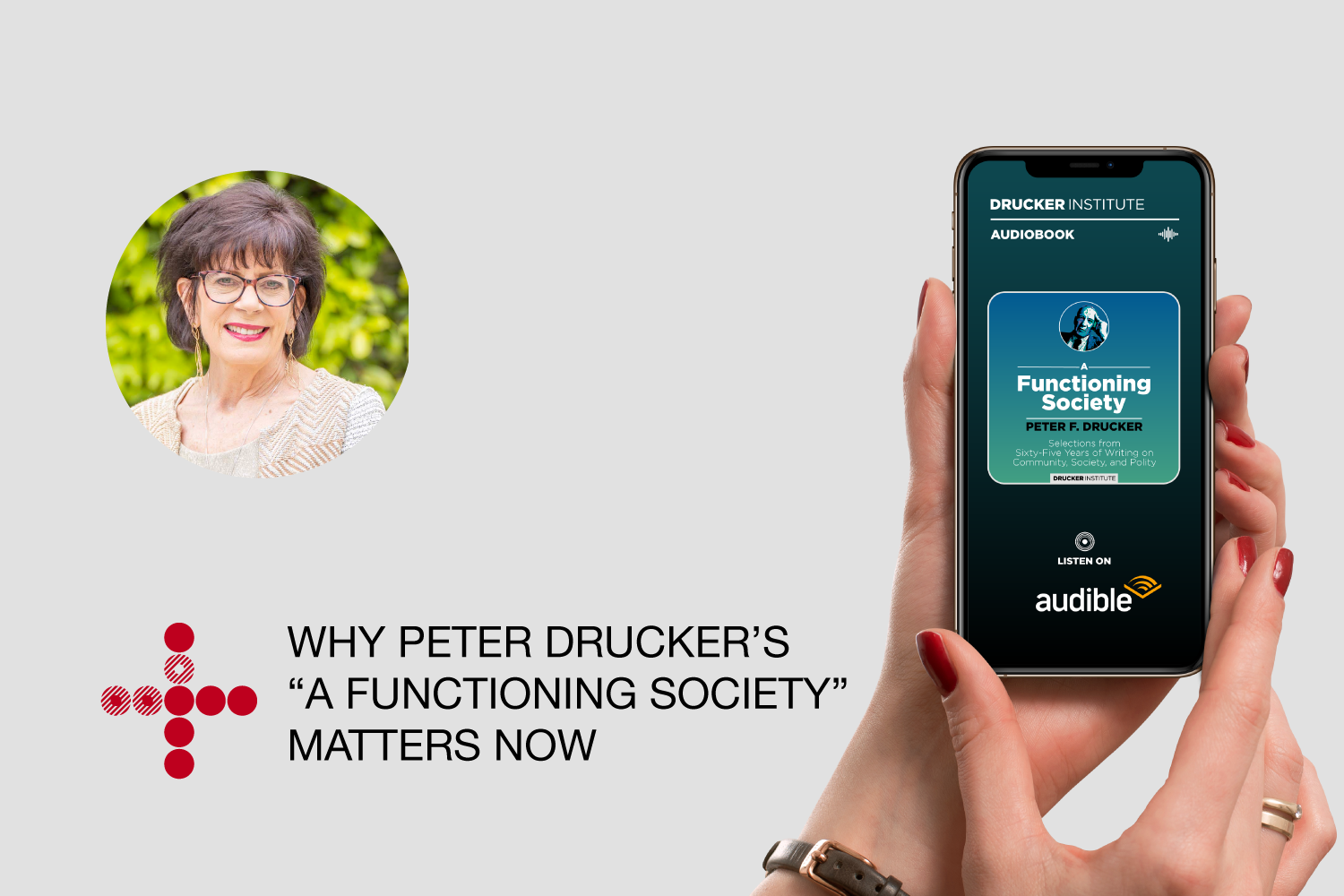
By Dr. Kristine Marin Kawamura
Director of Societal and Global Impact, Clinical Full Professor of Management
The Drucker–Ito School of Management, Claremont Graduate University
Why Peter Drucker’s A Functioning Society matters today, and what it reveals about institutions, responsibility, and social breakdown.
Why This Book, Why Listening, Why Now?
There is something distinctive about encountering Peter Drucker’s ideas through listening rather than reading. The sentences unfold without urgency or rhetorical flourish. They sound less like exhortation than diagnosis. Heard aloud, A Functioning Society reveals itself not as a book of prescriptions, but as a sustained inquiry into responsibility—one that resists speed, summary, and easy resolution.
This is not a management book in the usual sense. It is a warning—and a plea—about what happens when societies lose the capacity to function humanly. Drucker was not asking how organizations can perform better. He was asking a more unsettling and prior question: what must institutions do so that society itself does not break down?
That question feels newly urgent today. Across many societies, people are waking up to signals that institutions are under strain: rising distrust, hollowed-out systems that still perform, the return of authoritarian promises, and a growing sense that responsibility is being pushed onto individuals rather than carried structurally. These are not isolated events, but symptoms Drucker recognized decades ago as early signs of a society moving toward dysfunction.
For Drucker, this concern was not theoretical. Having witnessed the collapse of European institutions in the interwar period and the rise of totalitarian movements, he understood that social breakdown begins long before tyranny takes hold. It starts when institutions fail to provide meaning, legitimacy, and responsibility—when people no longer experience themselves as participants in a society that works. As he warned, “A society which does not function—no matter how well it may perform economically—will destroy itself.”
A Functioning Society brings together Drucker’s reflections across several decades and multiple books, each approaching the same concern from a different angle: what it takes for a society to function rather than fracture. He uses the term functioning society to describe one in which institutions are capable of carrying responsibility, legitimacy, and meaning over time. Institutions, he insists, exist to serve society—and when they fail in this task, the consequences are social before they are political.
“A society which does not function—no matter how well it may perform economically—will destroy itself.”
How Peter Drucker Explained Social Collapse
Drucker’s thinking is shaped by his observation that totalitarianism is not the beginning of social collapse, but its end result. He saw how the erosion of institutional legitimacy, the concentration of power without responsibility, and the loss of meaningful participation created a vacuum that extremist movements rushed to fill. “Totalitarianism is not the cause of social breakdown; it is the result,” he wrote.
For Drucker, institutions are meant to mediate between individuals and power. When they fail to do so—through domination, neglect, or fragmentation—individuals are left exposed to forces they cannot reasonably absorb on their own. The lesson he draws is not ideological, but structural: societies unravel when institutions no longer function.
“Totalitarianism is not the cause of social breakdown; it is the result.”
What a Functioning Society Requires, According to Drucker
When Drucker speaks of a functioning society, he is not offering a moral blueprint or an idealized vision of harmony. He is asking whether institutions can actually do the work they exist to do. A functioning society is one in which institutions integrate individuals into meaningful roles, channel power responsibly, and sustain legitimacy across change. “The test of any institution is not what it promises but what it contributes to society.”
Just as importantly, a functioning society is not defined by performance alone, economic success, or ideological conformity. A society may be productive, technologically advanced, or politically stable and still be non-functioning in Drucker’s sense if its institutions cannot carry responsibility humanly. Economic performance alone does not make a society function. Function, for Drucker, is always human before it is technical.
Responsibility is the linchpin. Institutions must be able to bear the consequences of their power structurally, rather than pushing those consequences onto individuals, society, or the future. Power without responsibility is destructive; responsibility without power is futile. This balance—so often treated as abstract—is, for Drucker, the condition of social survival.
“The test of any institution is not what it promises but what it contributes to society.”
Institutions, Management, and Social Responsibility
Societies do not function—or fail—because of individual morality alone. They function through institutions: corporations, nonprofit organizations, governments, and voluntary, educational, and religious bodies that give individuals meaning, belonging, and a place in society. When these institutions work, society holds together. When they do not, responsibility reappears elsewhere—in economic dislocation, ideological movements that promise false meaning, social fragmentation, and the concentration of unchecked power.
Management plays a decisive role here. Drucker treats management not as a technical discipline, but as a social function. Managers are custodians of institutional power, responsible not only for results, but for exercising authority in ways that preserve human dignity and institutional legitimacy. Management’s task, he wrote, is to make institutions both productive and humane.
This framing challenges contemporary tendencies to individualize failure or glorify leadership. Drucker is clear: no amount of personal virtue can compensate for institutional arrangements that concentrate power without responsibility or demand sacrifice without meaning. When management fails in its social function, the consequences extend beyond organizations. They weaken society itself.
Why A Functioning Society Still Matters Today
One of the most misunderstood aspects of A Functioning Society is that Drucker is not describing a single ideal form of society. He explicitly rejects the idea that there is one correct structure or moral code. “There is no one right society,” he writes, “no one right institutional structure. There is only the question whether a society functions or does not function.”
For contemporary leaders, this question is not abstract. It shows up as lived experience: feeling responsible for outcomes you cannot fully control; working inside systems that perform well while feeling increasingly hollow; being blamed individually for failures that are structural rather than personal. These experiences are not signs of personal inadequacy. They are signals of institutional strain.
Seen through Drucker’s lens, many of today’s disruptions—terrorism, mass protest, authoritarian movements, economic instability, and large-scale migration—can be understood as related indicators rather than isolated crises. They point to institutions that are no longer carrying responsibility in ways people experience as legitimate or just.
“There is no one right society...no one right institutional structure. There is only the question whether a society functions or does not function.”
Why Listening to A Functioning Society Matters
Drucker never claimed to offer a definitive model of a functioning society. What he offered instead were criteria for function—tests that societies and institutions must continually meet if they are to endure. He is not asking us to admire institutions or to measure their success by scale or performance alone. He is asking whether they are capable of bearing responsibility without eroding the society they serve.
What has changed since Drucker’s time is not the definition itself, but the intensity of the demands placed upon it. Listening to A Functioning Society today is a reminder that social function is not guaranteed by success or scale. It must be governed, renewed, and sustained deliberately, again and again, if society itself is to continue functioning at all.
Hearing this book now—spoken slowly, without compression—makes clear that it is not a text to skim or abstract, but one to live with. For managers and leaders especially, the audio edition offers something rare: time to sit with the weight of institutional responsibility, and to hear Drucker’s question as he intended it—not as a theory to master, but as a responsibility to carry.
Inspired by Drucker’s wisdom?
Peter Drucker changed how the world thinks about management.
The Drucker School of Management applies those ideas today through its graduate education, research, and community engagement. Learn more about how they carry forward his vision.
The Drucker Institute promotes effective management and responsible leadership as foundational elements that contribute to Drucker’s vision for a thriving, resilient, and functioning society.