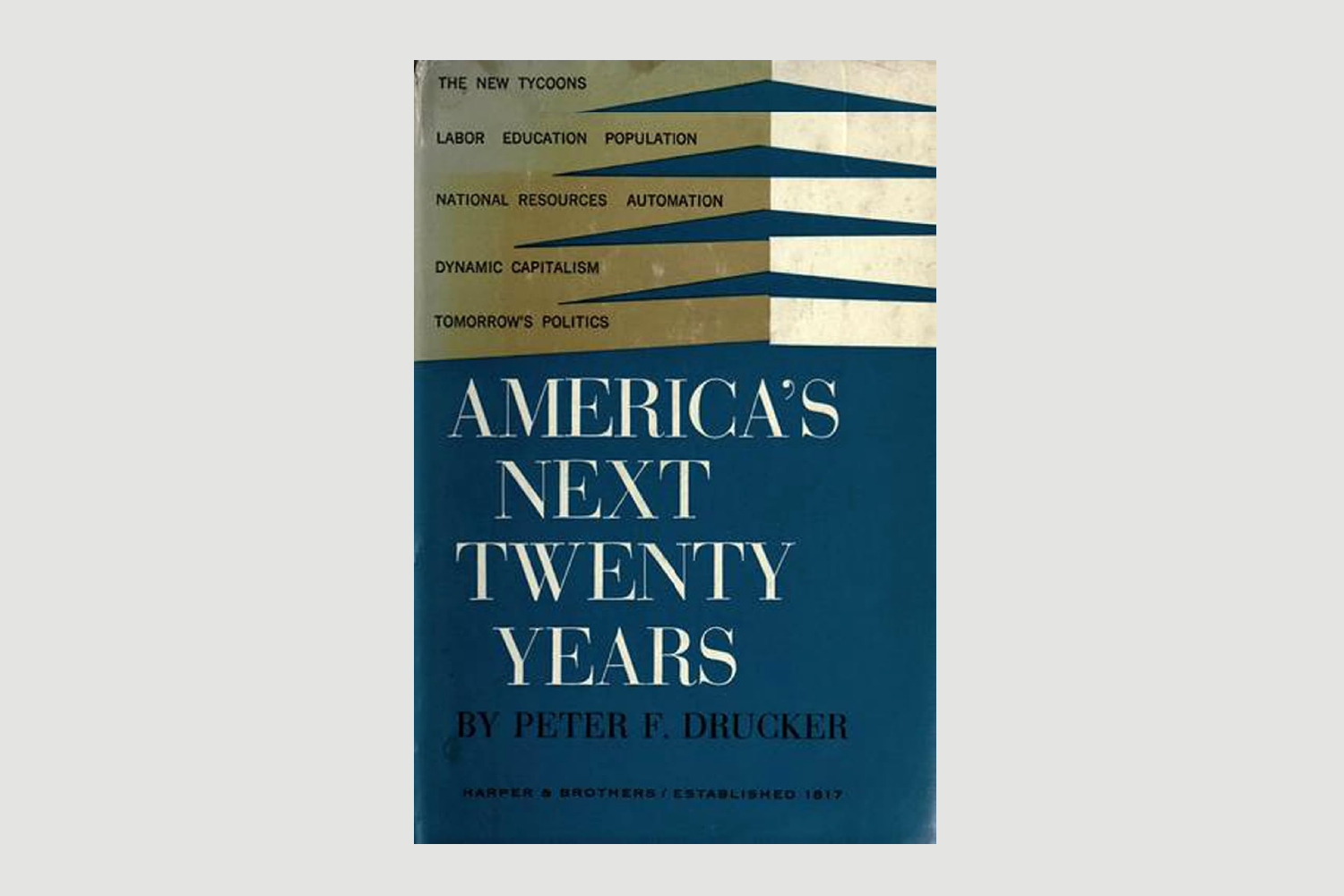
America’s Next Twenty Years
Author: Peter F. Drucker, 1957
Book preface written by Drucker+ team.
Off the Shelf highlights the books of Peter F. Drucker. This week, we look at Drucker’s sixth book, “America’s Next Twenty Years,” published in 1957.
“America’s Next Twenty Years” is a collection of essays that Drucker first published in Harper’s Magazine. It’s a book of predictions. In it, Drucker attempts to forecast the effects major changes — such as those related to demographics and technology — will have on American society, business, and politics.
It’s a short book but one of significant breadth, containing chapters on automation, higher education, and the consolidation of wealth and power in the hands of a select group of business leaders.
In the chapter “The Promise of Automation,” Drucker anticipates an argument that is often heard today in relation to AI adoption, that automation won’t necessarily lead to mass unemployment, but will require workers to acquire new knowledge and skills that complement work done by machines. “Automation will upgrade the semi-skilled machine operator of today into a highly skilled and knowledgeable technician — multiplying his income,” he writes.
That said, an increase in machines doing things that were once done by humans would place a significant strain on the American educational system to train workers for these higher-level roles, to "up-skill" workers, using a contemporary phrase.
Drucker also discusses the challenges the United States will face in terms of access to finite natural resources and the way trade imbalances could influence the health of the domestic economy.
In the next 20 years, Drucker writes, foreign affairs will play a major role in American political discourse, and “the demands that an expanding economy will make on public policy are clearly so great and so new that they will force drastic changes in political alignments, organizational structure, and voting patterns.”
Nearly 70 years later, “America’s Next Twenty Years” is a reminder that some of the most pressing questions Drucker identified related to automation, education, resource constraints, and political realignment, are ones we are still trying to answer.
“The demands that an expanding economy will make on public policy are clearly so great and so new that they will force drastic changes in political alignments, organizational structure, and voting patterns.”
Hardcover on Amazon
Limited Availability - Out of Print: Order now on Amazon.com