What Corporate Social Responsibility Really Measures
People are the organization.
Drucker Institute’s Data Innovation Team
July 2026 Edition
By Daniel Martin of the Data Innovation Team at The Drucker Institute.
Most leaders know corporate social responsibility matters.
The harder question is what CSR actually is.
Is it environmental stewardship? Ethical governance? Fair treatment of employees? Responsible supply chains? Community impact? Product responsibility? The answer is yes—but that answer creates a measurement problem. If CSR includes all of these things, how should leaders understand whether a company is truly responsible, or merely strong in one visible area?
The Drucker Institute’s Corporate Effectiveness Rankings have long treated Corporate Social Responsibility as one of the core dimensions of effective management which encapsulates a key Drucker tenet: organizations are accountable not only for what they produce, but also for how their decisions affect people, communities, and society.
This year, our Data Innovation Team examined the structure behind the CSR dimension in our 2025 public firm rankings data. We wanted to understand whether the many CSR indicators we use behave like separate categories, one broad construct, or something in between.
Why CSR is hard to measure
Corporate responsibility has evolved over time. Early views emphasized philanthropy, legal compliance, and ethical conduct. Later frameworks expanded the focus to stakeholders, sustainability, and the “triple bottom line” of people, planet, and profit. Today, ESG measurement often translates those ideas into data: environmental impact, social responsibility, and governance quality.
That breadth is useful, but it also creates noise in the data. Two companies can receive similar CSR scores for different reasons. One may lead on emissions, another on workforce practices, and another on governance transparency. A leader looking at a single score might reasonably ask: are these really the same thing?
Our goal was to take a deeper look at the Drucker CSR dimension by looking to understand which CSR indicators naturally move together across firms, and whether those patterns reveal something useful for leaders.
“How responsibly does a company manage its impact?”
Where we started
We began with a theory-informed map of CSR. CSRHub provided the clearest organizing framework because its categories distinguish between environmental performance, employee-related responsibility, community responsibility, and governance. That structure also fits the broader ESG tradition: environmental, social, and governance responsibility, with social responsibility split between stakeholders inside the organization and stakeholders outside it.
We then brought together CSR indicators from multiple sources used in the Drucker Institute’s 2025 rankings, including CSRHub, HIP Investor, Sustainalytics, and the Supply Chain Resource Cooperative.
Rather than assume that every source was measuring the same thing, we treated the sources as different windows into the same broad question: how responsibly does a company manage its impact?
How we studied the structure
We used a latent factor discovery process. In plain language, factor analysis asks a simple question: when companies score high on one indicator, which other indicators tend to move with it?
If environmental indicators move together, that suggests an environmental CSR pattern. If workforce indicators move together, that suggests a human-capital pattern. If governance indicators move together, that suggests a governance pattern. And if all of these indicators move together, that suggests a broader generalized CSR capability.
The process began broadly. We first explored the full CSR item pool across all sources. That broad search was informative, but not clean enough on its own. Some patterns appeared to reflect data-source differences more than meaningful CSR dimensions. In other words, indicators sometimes clustered because they came from the same provider, not because they represented the same underlying construct or process.
That led us to a more disciplined second step. We organized indicators into theory-guided pools—environmental stewardship, internal social responsibility, external stakeholder responsibility, and governance—and then tested whether those pools held up statistically.
What we found
The CSR data did not behave like a random collection of unrelated indicators.
We found recurring clusters around four broad ideas:
#1 - Environmental stewardship: how firms manage energy, emissions, resources, waste, water, and environmental policy.
#2 - Internal social responsibility: how firms treat employees through safety, benefits, training, retention, diversity, and human-capital management.
#3 - External stakeholder responsibility: how firms affect communities, customers, supply chains, products, human rights, and broader stakeholder relationships.
#4: Governance and ethics: how firms manage board quality, leadership ethics, transparency, reporting, accountability, certifications, and business ethics.
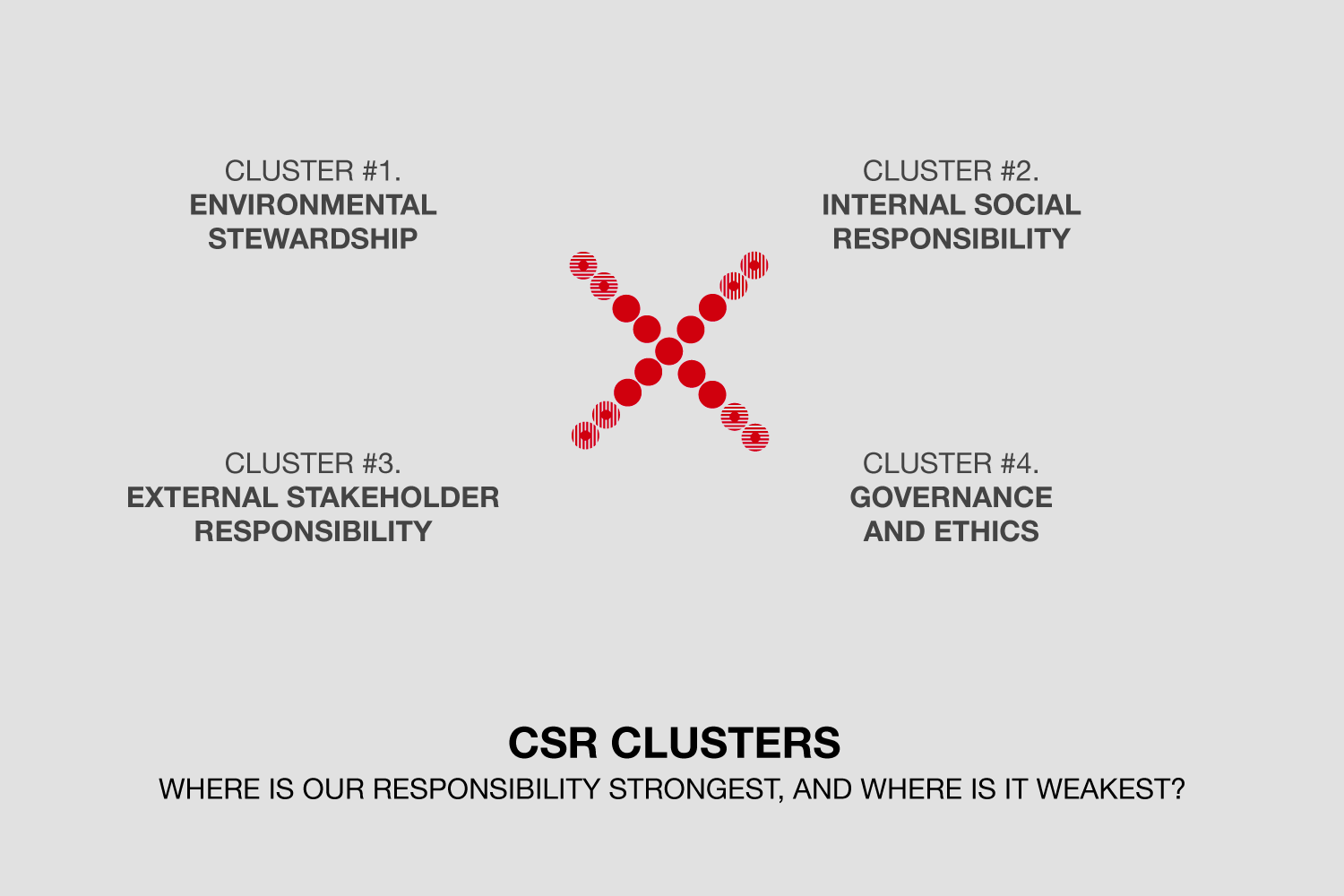
Those clusters matter because they give leaders a more interpretable map of CSR. A company can ask not only, “How responsible are we overall?” but also, “Where is our responsibility strongest, and where is it weakest?”
But the most important finding was broader.
The strongest signal in the data was not any single CSR subcategory. It was a general CSR factor running through the indicators. Firms that performed well in one area of responsibility tended to perform well in others. Environment, workforce, stakeholder responsibility, and governance were not fully separate silos—they were connected.
That suggests socially responsible firms do not simply pick one lane. They appear to build systems, routines, and commitments that show up across many parts of the organization.
“Socially responsible firms do not simply pick one lane. They appear to build systems, routines, and commitments that show up across many parts of the organization.”
What this means for leaders
The practical lesson is that CSR should not be managed as a set of disconnected checkboxes.
A company can launch an environmental initiative, publish a governance report, or improve a supplier policy. Those actions matter. But the data suggest that stronger CSR may come from something more integrated: a management system that supports transparency, accountability, stakeholder awareness, and long-term stewardship across the firm.
For leaders, that changes the question. Instead of asking, “Which CSR box should we check next?” they might ask:
What capabilities help us act responsibly across functions?
Where do our CSR weaknesses reveal broader management gaps?
Are we strong in one visible area but weak in the systems that make responsibility durable?
This matters because CSR is not only about reputation. It is about whether a company is building trust with the people and institutions it depends on: employees, customers, suppliers, communities, investors, and regulators.
Why this matters for the Drucker rankings
The Drucker Institute’s rankings are built on the belief that effective companies do the right things well. CSR is central to that idea because responsible management is not separate from effectiveness. It is part of what makes effectiveness sustainable.
Our analysis helps clarify the CSR dimension by showing that the underlying data contain both specific patterns and one strong common thread. The specific patterns help diagnose where responsibility is expressed. The common thread helps explain why CSR belongs in a broader model of corporate effectiveness.
A company may express responsibility differently depending on its industry. For example, environmental stewardship may look different in energy than in software. Product responsibility may matter differently in pharmaceuticals than in financial services. Governance and transparency may take different forms across sectors.
But the broader idea remains: responsible firms tend to show coherence across multiple areas of impact.
What’s next?
Next month, we will examine how CSR is expressed across industries in the 2025 Drucker Institute Corporate Effectiveness Rankings.
We will begin by asking: do technology firms show a different CSR profile than retailers? Do industrial firms express responsibility more through environmental management? Do service firms show responsibility more through workforce and stakeholder practices? And do different CSR weaknesses matter more in some industries than in others?
Our goal is not to create an academic model for its own sake. It is to make corporate responsibility easier to understand, easier to diagnose, and easier to manage. These questions will help us move from measurement to management. If CSR is a system, leaders need to know how that system works in their own industry.
"People are the organization."
That conviction sits at the center of the research agenda we are launching this year. Peter Drucker taught that productivity is not simply the responsibility of the worker. It is a function of how organizations manage, measure, and support the people who do the work.
At the Drucker Institute’s Data Innovation Team, we are translating that insight into rigorous, actionable research. Our central aim is to understand how employee signals move over time, what they reveal about organizational health, and how they relate to financial outcomes.
Over the coming year, we will publish a series of short monthly pieces that pull back the curtain on our projects. Our purpose is straightforward. We want to make the best social science methods useful for leaders and boards so they can make clearer, evidence-based decisions about people and performance.
Read this original essay for a snapshot of the research agenda guiding our first major wave of work.

The Drucker Institute’s Data Innovation Team
Who Is Doing the Work
This effort reflects a genuinely cross disciplinary team.
Becky Reichard leads the conceptual framework and literature integration.
Daniel Martin coordinates data engineering and model implementation.
Chasen Jeffries is developing the fatal flaw framing.
Xu Chen leads the topic modeling and validation pipelines.
Dana Bellinger is writing the employee engagement methodology.
Emily Alpay De Ruyter is leading the financial performance modeling.
Steven Zhou provides consultation on quantitative methods and psychometrics.
See the full team on the Drucker Institute website.
Together, this mix of scholars, data scientists, and practitioners forms the engine required to translate rigorous research into practical insight.
At the Drucker Institute, we believe that what gets measured shapes what gets managed. If people are the organization, then understanding employee signals with clarity and discipline is not a side project. It is central to the work of building effective, responsible, and enduring enterprises.
Inspired by Drucker’s wisdom?
Peter Drucker changed how the world thinks about management.
The Drucker School of Management applies those ideas today through its graduate education, research, and community engagement. Learn more about how they carry forward his vision.
The Drucker Institute promotes effective management and responsible leadership as foundational elements that contribute to Drucker’s vision for a thriving, resilient, and functioning society.